

Why Paid Media Optimisation Misses the Point | GTM Insight

Duncan Rooney
CMO & Keyser Söze
Jan 28, 2026
The Usual Suspects Problem: Why Most Paid Media Optimisation Misses the Point
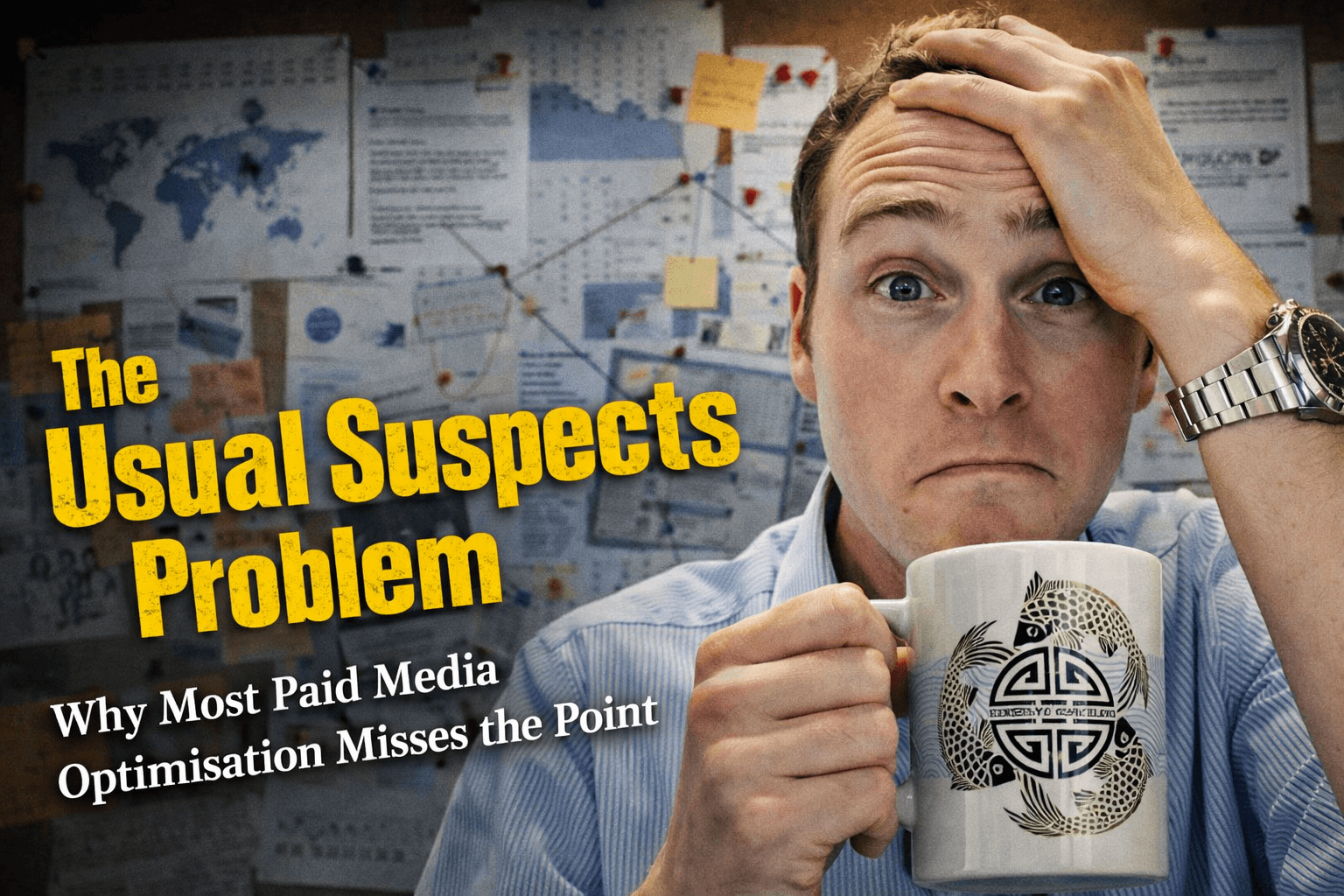
In The Usual Suspects, the story feels airtight — until it isn’t.
Every detail seems to line up. The names, the clues, the evidence pinned to the board. It all makes sense, right up until the moment you realise the narrative was built from assumptions that were never properly questioned. The truth wasn’t hidden. It was visible the whole time — just misunderstood.
Paid media often fails in exactly the same way.
Dashboards are full.
Channels are live.
Optimisation logic is sound.
And yet performance stalls, costs rise, and confidence drops.
So teams do the most rational thing available: optimise harder.
More tests. More tweaks. More focus on the channel.
It feels sensible. It’s also often the wrong move.
When optimisation becomes misdirection
When paid media underperforms, the diagnosis is almost always channel-led:
Targeting needs refining
Bids need adjusting
Platforms have become too expensive
Algorithms have “changed”
Any of these might be true. They’re rarely the root cause.
Channels amplify messages. They don’t fix them.
If the underlying story is unclear or unconvincing, optimisation simply makes the wrong narrative louder. At that point, activity looks like progress — but it’s really misdirection.
Just like the noticeboard in The Usual Suspects, everything appears connected. The conclusions feel earned. And yet the framing itself is flawed.
The clues are usually in plain sight
The warning signs tend to show up early — they’re just easy to misread.
Things like:
Decent click-through rates with weak conviction downstream
Lots of “learning” but no clearer story
Endless creative testing without meaningful insight
Rising spend without growing confidence
These are treated as optimisation problems. More often, they’re signals that the narrative isn’t doing enough work.
A marketplace example (high-level)
In the context of a two-sided marketplace I was previously involved with — outlined at a high level in my Homesty case study — paid media performance was initially viewed through a familiar lens: traffic, efficiency, and channel mechanics.
On paper, everything looked reasonable. Spend was live. Audiences were defined. Activity was consistent.
But the more the team optimised, the clearer it became that the issue wasn’t distribution — it was interpretation. The market context was nuanced. Trust mattered. The value exchange wasn’t landing clearly enough.
The decision that mattered wasn’t how to optimise spend.
It was what story we were asking the market to believe.
Until that was resolved, no amount of channel tuning was going to change the outcome.
Once the narrative was clarified — tone, message, and positioning — performance started to behave very differently. Not because the channels changed, but because the thing being amplified finally made sense.
The clues had been there all along.
Creative isn’t subjective when money is involved
Creative is often treated as a soft discipline — aesthetic, subjective, downstream of “real” growth work.
That’s a mistake.
Creative is a commercial input.
It shapes how value is understood, trusted, and acted on.
When performance dips, optimisation feels safer than fixing the story. It’s measurable, controllable, and easy to justify. Stepping back to address narrative clarity is harder — and that’s exactly why it gets avoided.
The GTM mistake leaders keep making
The common GTM error isn’t choosing the wrong channel.
It’s separating decisions that are actually the same decision, viewed at different altitudes:
Brand
Creative
Performance
Growth
They’re not sequential. They’re interdependent.
Optimising distribution before fixing narrative is like rearranging the evidence board while still believing the wrong story.
What this means for leaders
When growth stalls, the most commercial move is often not more activity.
It’s stopping long enough to ask:
What assumptions are we making?
What story are we amplifying?
And what evidence are we selectively interpreting to support it?
The smartest teams don’t optimise faster — they diagnose better.
That’s the real lesson from The Usual Suspects. The failure wasn’t a lack of intelligence. It was misplaced confidence in a narrative that felt coherent, but wasn’t true.
Paid media works best when it’s amplifying clarity — not compensating for its absence.
This is why marketplace and platform growth isn’t about scaling channels — it’s about fixing the system before you amplify it.
Sign-off
When strategy needs momentum and momentum needs direction, I can help you get there.