


The Pen Is Blue: Why Marketing Runs on Assumptions

Duncan Rooney
Fractional CMO
Jan 20, 2026
**Modern marketing doesn’t run on lies.
It runs on assumptions we all silently agree not to challenge.**
Not because people are dishonest.
But because decisions still need to be made, targets still need to be hit, and confidence still needs to be projected.
So assumptions get smoothed out.
Uncertainty gets dressed up as certainty.
And somewhere between the spreadsheet and the board deck, best guesses quietly become facts.
No one signs anything, but everyone knows the deal.
It’s the unspoken NDA of modern marketing.
The Comfortable Fiction
Most marketing plans are built on things we think are true:
attribution models that imply clarity
forecasts that assume stability
CAC figures that ignore saturation
pipelines that assume intent
channels that “should” keep scaling
And to be clear — none of this is malicious.
It’s just… convenient.
Because saying:
“This is our best estimate based on incomplete data”
feels a lot riskier than saying:
“The data shows…”
So we choose the second.
That’s not lying.
That’s organisational survival.
Why We All Play Along
There’s a reason these assumptions rarely get challenged.
Admitting uncertainty:
slows decisions
invites debate
exposes fragility
makes leadership uncomfortable
And in fast-moving businesses, discomfort is often treated as inefficiency.
So instead, teams optimise within the assumptions:
refining numbers
improving dashboards
debating decimal points
adjusting forecasts
All while quietly accepting that the foundations are shaky.
Everyone knows it.
No one says it.
The Problem Isn’t the Assumptions — It’s Pretending They’re Facts
Assumptions aren’t bad.
They’re unavoidable.
What is bad is pretending they don’t exist.
That’s how you end up with:
false confidence
over-optimisation
repeated surprises
plans that look right but don’t work
The more complex marketing becomes, the more dangerous this gets.
Because complexity amplifies error.
And when assumptions are buried, they can’t be tested — only defended.
This Is Why Dashboards Feel Reassuring (and Misleading)
Dashboards create the illusion of control.
They look precise.
They feel objective.
They give everyone something to point at.
But dashboards don’t tell you why something is happening.
They tell you what is happening — filtered through assumptions you rarely see.
When performance dips, the reflex is:
more data
more reporting
more attribution
more tools
Rarely:
better questions
clearer thinking
or a re-examination of the assumptions underneath it all
That’s how teams end up working harder… without moving forward.
The Leadership Gap: When the Data Is Incomplete, Someone Still Has to Decide
This is the part that rarely gets said out loud.
When the data is incomplete —
someone still has to make the call.
That’s where leadership shows up.
Not in pretending certainty exists.
But in:
naming assumptions
understanding their risk
sequencing decisions
and designing learning loops to validate or kill them
This is why senior roles can’t be automated away.
Judgement fills the gaps data can’t.
Making Assumptions Explicit Is a Superpower
The strongest teams I’ve worked with don’t pretend they have perfect information.
They say things like:
“This is our assumption — let’s test it”
“This is directional, not definitive”
“Here’s what would change our mind”
That changes everything.
Suddenly:
strategies become adaptable
teams learn faster
decisions improve
and failure becomes informative, not political
Uncertainty stops being a weakness.
It becomes a tool.
Why This Matters More Than Ever
Marketing today is:
more complex
more expensive
more visible
and more accountable
The cost of getting assumptions wrong is higher than ever.
And yet, the pressure to appear confident has never been stronger.
That tension is where most growth problems live.
Not in channels.
Not in tools.
Not in tactics.
But in the gap between what we know and what we say.
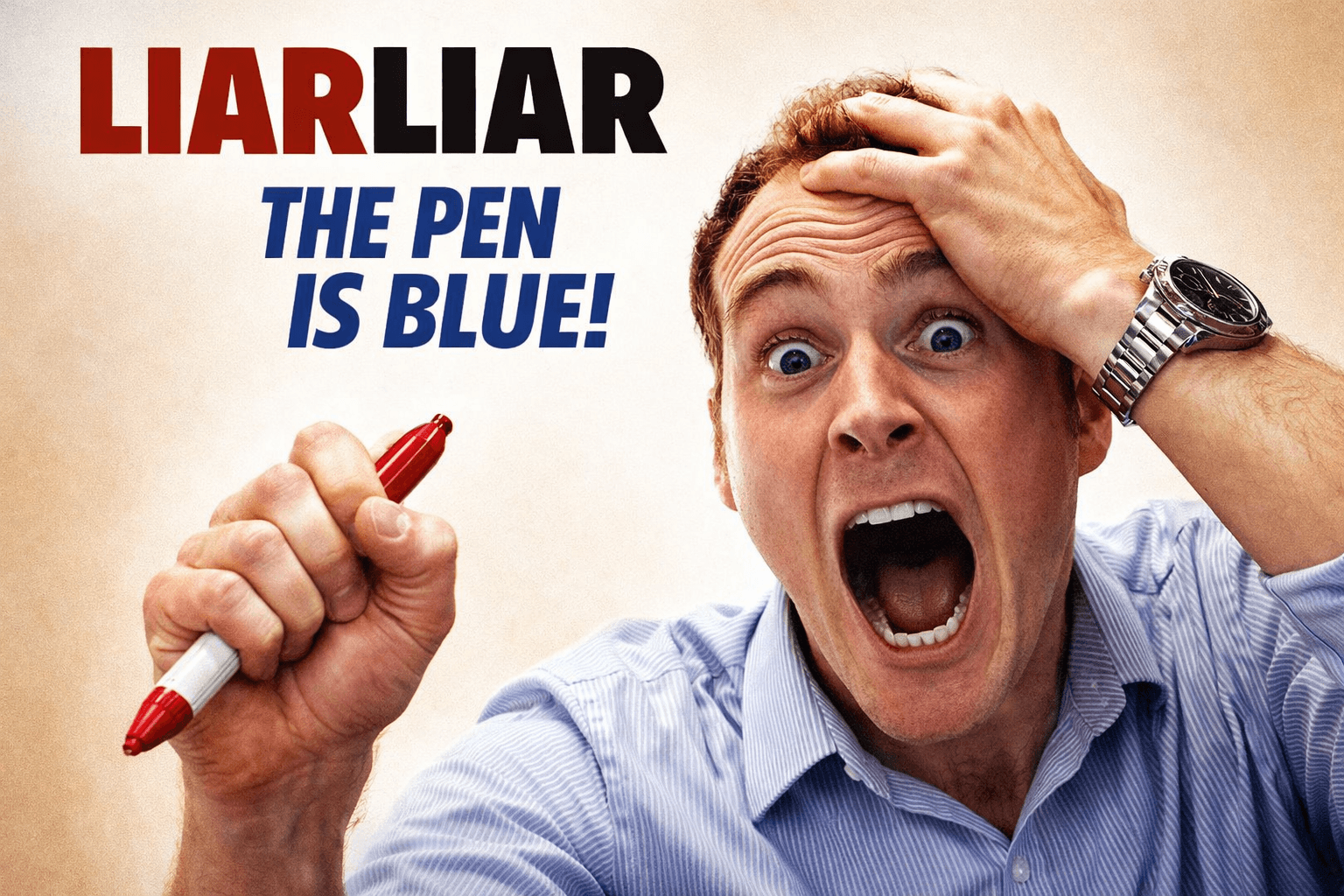
The Pen Is Blue Moment
In Liar Liar, the joke works because the truth can’t be avoided.
“The pen is blue.”
In marketing, we rarely force that moment.
We let the fiction stand.
We optimise around it.
And we’re surprised when outcomes don’t change.
Sometimes the most valuable thing a leader can do is pause and say:
“Let’s be honest about what we’re assuming.”
That’s not weakness.
That’s clarity.
Final Thought
Modern marketing doesn’t need more data pretending to be truth.
It needs:
clearer thinking
more honesty about uncertainty
and leaders willing to challenge the assumptions everyone else is quietly protecting
Because when assumptions are visible, they can be tested.
And when they’re tested, progress finally becomes possible.
That’s not anti-data.
It’s pro-reality.
Sign-off
When strategy needs momentum and momentum needs direction, I can help you get there.