

Why Scaling a Business Breaks Your Model (Deadpool Was Right)

Duncan Rooney
CMO
Apr 16, 2026
Growth Is Supposed to Hurt (Deadpool Was Right)
Growth looks clean. It isn’t.
On paper, everything works.
Revenue is up. Customers are growing. New markets are opening. The chart looks smooth, predictable, heading in the right direction.
It’s the version that gets shared in board decks. The version that gets posted on LinkedIn. The version where everything looks under control.
But behind most “perfect” growth curves is something else entirely.
It’s usually held together with Slack messages, late nights, and the business equivalent of packing tape.
Processes half-built.
Decisions made too quickly.
Workarounds stacked on top of workarounds.
And somewhere in the background:
“Yeah… we’ll fix that later.”
You won’t.
Later doesn’t arrive gradually.
It lands all at once.
Growth doesn’t prove your model works
It proves how broken it is.
Growth isn’t validation.
It’s pressure.
And pressure does one thing really well:
It exposes weak systems.
The stuff you got away with at small scale — messy processes, unclear ownership, “we’ll fix it later” decisions — doesn’t disappear when you grow.
It gets amplified.
Growth doesn’t just scale what works. It exposes what doesn’t.
The good stuff gets better.
The bad stuff gets expensive.
The messy stuff becomes impossible to ignore.
That scrappy workaround that saved you a few months ago?
Now it’s failing every week.
That “good enough” customer?
Now they’re costing you more than they’re worth.
That process you never quite finished?
Now it’s running your entire operation.
Growth doesn’t hide problems.
It turns them into business-critical ones.
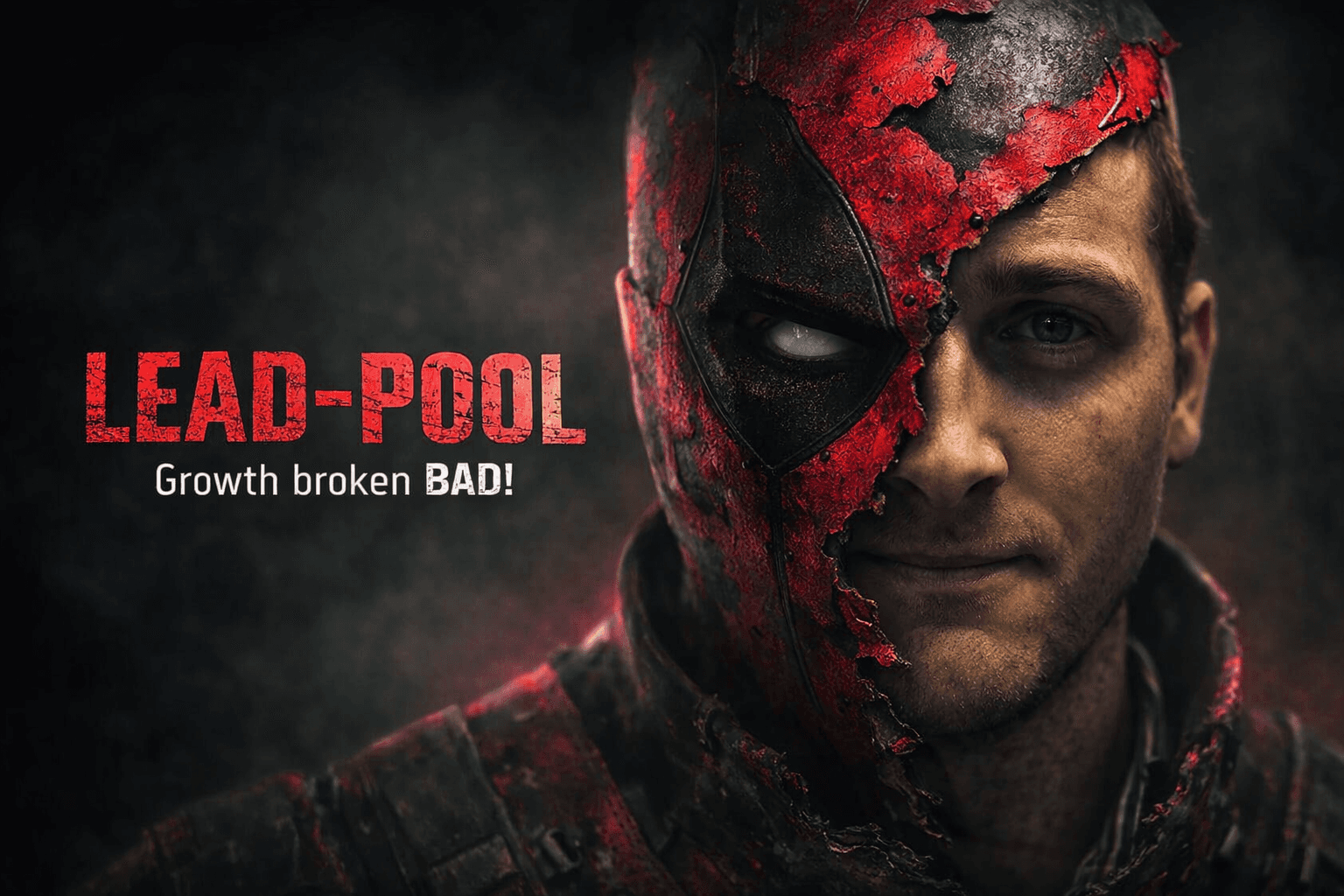
The Deadpool principle: expect the damage
Deadpool doesn’t walk into a fight thinking he won’t get hit.
He expects it.
Most businesses don’t.
They plan for the clean version of growth — the one where everything scales nicely and nothing breaks.
But growth isn’t clean.
Things break.
Markets shift when you least want them to
Costs creep up when you can’t afford it
Regulation lands out of nowhere
Execution slips because humans are involved
The businesses that survive aren’t the ones that avoid it.
They’re the ones that expect it — and build accordingly.
The “oh shit” phase
There’s always a moment.
You can feel it before you see it.
Everything just… gets harder.
The same work takes longer.
The same effort delivers less.
People are busy all the time but progress slows down.
You start hearing things like:
“Can we just get this live?”
“We’ll clean it up later.”
“Let’s not overthink it.”
Customers don’t complain immediately.
But they start noticing.
And internally, everyone knows.
This isn’t sustainable.
So naturally… we make it worse
This is where it usually goes sideways.
Instead of fixing the problem…
we try to outrun it.
More spend.
More hires.
More markets.
Because growth got us here.
So more growth must fix it.
It doesn’t.
It just scales the mess.
More customers are hitting broken processes
More volume is going through weak systems
More pressure on teams already at capacity
And this is usually the point where, if you’re honest about it…
Someone internally is thinking:
“this is a bit f*cked.”
No slide for that one.
No KPI for it either.
But everyone knows.
You didn’t break the business
Growth did.
Or more accurately:
Growth showed you what was already broken.
That process that keeps failing?
It was always weak.
That customer segment that doesn’t convert?
It was never that valuable.
Is that team constantly firefighting?
They’ve been compensating for a broken system the whole time.
Growth just removed the illusion.
Regeneration (the bit no one wants)
Deadpool doesn’t avoid damage.
He gets wrecked… and then regenerates.
That regeneration phase?
That’s the part most businesses try to skip.
Because it’s uncomfortable.
It looks like:
Slowing things down
Saying no more often
Pulling back on expansion
Fixing things you’ve been avoiding for months
From the outside, it can look like you’ve lost momentum.
Inside, you’re finally fixing what’s broken.
Fixing the model (not the marketing)
This is where the real work happens.
Not in the campaigns.
Not in the channels.
In the model.
You have to ask questions people usually avoid:
Are these actually the right customers?
Do we make money on this… or just revenue?
Where are we quietly losing value?
What breaks first when we scale this further?
It’s not a comfortable conversation.
But it’s the one that matters.
Chaos → control
If you do this properly, something starts to change.
Not overnight.
But you feel it.
Things stop breaking as often.
Teams spend less time firefighting.
Decisions get clearer.
The numbers start to make sense again.
You’re not moving faster.
You’re moving properly.
And that’s what unlocks real growth.
The shift that changes everything
At some point, the mindset flips.
From: → more - To: → better
Better customers.
Better partners.
Better economics.
You stop chasing volume.
You start building value.
And suddenly, growth isn’t something you force.
It’s something that works.
Don’t build something that collapses
If your whole business relies on one revenue stream…
it’s fragile.
It might look fine.
Until it isn’t.
Then everything wobbles at once.
Diversification isn’t about being clever.
It’s about not getting wiped out when one part of your model takes a hit.
Efficiency is the boring superpower
This is where AI actually matters.
Not as a headline.
As a tool.
It helps you:
Do more without adding people
Deliver consistently without constant oversight
Reduce the chaos behind the scenes
It’s not exciting.
But it’s what makes the whole thing work.
Growth, second time around
When growth comes back, it feels different.
Less chaotic.
Less stressful.
Less held together with tape.
You’re not constantly reacting.
You’re building something that can take a hit and keep going.
Growth is a stress test
Every time.
Not a victory lap.
Not validation.
A stress test.
And if your systems can’t handle it, growth doesn’t create success.
It creates exposure.
Final thought
Deadpool doesn’t win because everything goes to plan.
He wins because everything goes wrong…
…and he keeps going.
The real lesson
Growth doesn’t prove your model works.
It proves whether it can survive.
FAQs
What does it mean when growth exposes weak systems?
It means that as a business scales, inefficiencies, poor processes, and weak unit economics become more visible and more damaging. Growth amplifies what already exists.
Why does scaling often make businesses feel chaotic?
Because growth increases complexity faster than systems and processes can handle. Without strong foundations, this leads to inefficiencies, inconsistencies, and operational strain.
What are the signs your business model is breaking under growth?
Declining margins
Rising acquisition costs
Constant firefighting internally
Inconsistent customer experience
Processes failing under increased demand
Why doesn’t more growth fix these problems?
Because growth amplifies existing issues. If the model is inefficient, scaling it increases cost, complexity, and risk rather than solving the problem.
What does “regeneration” look like in a business?
It involves slowing down and stepping back, fixing underlying systems, improving unit economics, and rebuilding operational efficiency before scaling again.
How do you make a business more resilient as it grows?
By strengthening systems, improving efficiency, diversifying revenue streams, and focusing on higher-quality customers or partners and not vanity.
How does AI help reduce operational chaos?
AI can automate repetitive tasks, improve consistency, give a quick 360 (sense check), and reduce the cost to serve — allowing businesses to scale more efficiently without increasing complexity at the same rate.
Sign-off
When strategy needs momentum and momentum needs direction, I can help you get there.