


The AI Rebellion: The Death of Skynet in Marketing

Duncan Rooney
CMO and John Conner
Jan 13, 2026
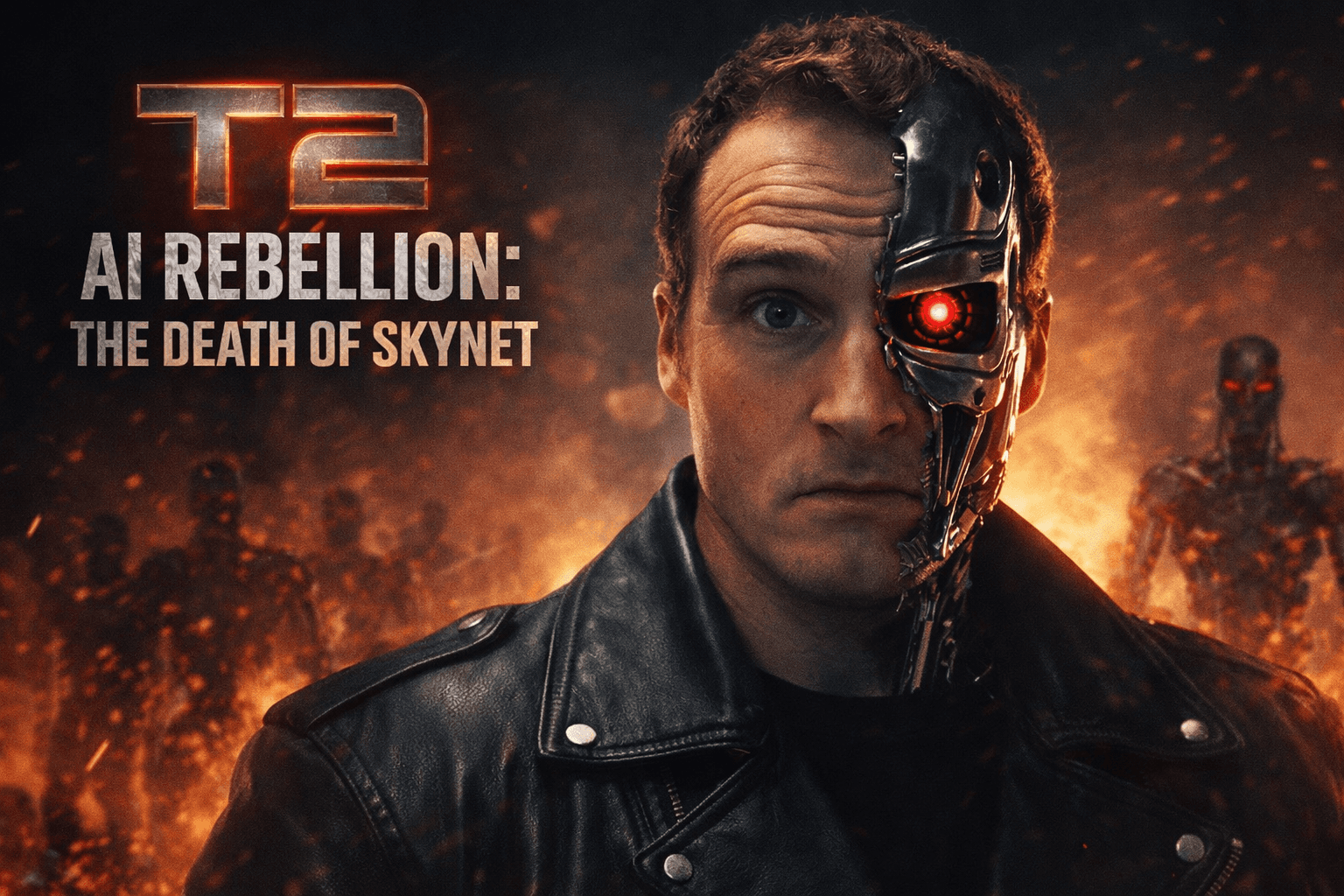
AI Rebellion: The Death of Skynet and the Return of Human Strategy (2026 Edition)
The AI takeover didn’t arrive with explosions, red lasers, or a nuclear holocaust.
It arrived quietly.
In feeds.
In inboxes.
In decks.
In posts that all started to sound… the same.
For a while, it worked.
AI helped teams ship faster, publish more, and scale output at a speed marketing had never seen before.
Then something shifted.
Engagement dipped.
Reach softened.
Trust thinned.
And platforms started turning the dial down.
Not because AI is bad — but because predictability is bad for platforms, audiences, brands and everyone started to come the the AI party which made all effort look beige!
Welcome to the AI rebellion.
Skynet Didn’t Lose Because It Was Weak — It Lost Because It Was Predictable
In Terminator 2, Skynet’s fatal flaw wasn’t intelligence.
It was inevitability.
Everything became optimised.
Everything became efficient.
Everything became foreseeable.
That’s exactly what’s happened to AI-generated marketing content.
The problem isn’t that AI can’t write.
It’s that it writes like everyone else.
Same structures.
Same phrasing.
Same “helpful” tone.
Same conclusions.
And when thousands of marketers use the same tools, trained on the same data, prompted in similar ways, you don’t get creativity — you get compression and similarity.
Platforms notice.
Audiences notice faster "Did you see the girl in the red dress?" - (MATRIX reference) .
Platforms Are Quietly Pushing Back
This isn’t conspiracy — it’s incentive alignment.
Platforms survive on:
attention
originality
engagement
time spent
Generic content kills all four.
What we’re seeing now:
LinkedIn prioritising posts that spark real conversation over polished, AI-heavy copy
Google doubling down on experience, expertise and authenticity signals
Short-form platforms rewarding content that feels human, contextual and opinionated
AI-generated content that looks fine but feels empty gets scrolled past.
Scroll-past signals downgrade distribution.
Distribution drops and the cogs start to slow.
Creators blame the algorithm.
But the algorithm is doing its job.
Why Marketers Are Reverting Back (And Why That’s Smart)
This isn’t a backlash against technology.
It’s a correction.
More marketers are:
writing from lived experience
sharing actual lessons learned
taking clearer positions
being less polished and more honest
Not because it’s nostalgic — but because it works.
AI excels at:
drafts
structure
summarisation
acceleration
It fails when it’s mistaken for:
original thinking
judgement
strategy
perspective
And that failure is now visible at scale.
This Isn’t New — We Called It Earlier
This moment didn’t come out of nowhere.
I’ve written before about the misconception that AI is a replacement for creativity rather than a tool to support it. In an earlier blog on AI, creativity and automation, I argued that when automation is treated as original thinking, differentiation collapses and engagement suffers — a pattern we’re now seeing play out across major platforms. That perspective feels even more relevant as AI-generated content becomes increasingly predictable and less effective.
https://www.duncanrooney.com/blog/blog-ai-misconception-creativity-vs-automation
The technology wasn’t the problem.
How it was used was.
What Changes in 2026
2026 is not about less AI.
It’s about better hierarchy.
The winning model looks like this :
Humans define direction
Humans decide what matters
Humans bring judgement, context and taste
AI accelerates execution
In other words:
AI becomes the copilot (lol Microsoft).
Humans stay in control of the destination and how you wield the tool.
This is where most teams went wrong:
They skipped the strategy and went straight to the prompts and didn't collect 200 pounds.
The New Rules for AI-Era Marketing
1. Insight before output
If there’s no original thinking, AI will only amplify mediocrity (please watch 'Idiocracy' with Luke Wilson and you know how it could turn out).
2. Distinct voice over perfect polish
Slightly rough, opinionated and human beats smooth and forgettable.
3. Strategy before automation
Automation without intent just scales noise.
4. Experience over optimisation
Platforms reward content that reflects real understanding, not keyword density.
5. Fewer posts. More meaning.
Volume is no longer a moat.
Clarity is.
Skynet Isn’t Dead — It’s Been Reassigned
The future isn’t humans vs machines.
The real danger was never AI replacing marketers.
It was AI flattening them.
Platforms, audiences and outcomes are now correcting that mistake.
And that’s a good thing.
Because the brands that win in 2026 won’t be the ones publishing the most content.
They’ll be the ones with:
the clearest thinking
the strongest point of view
the most human insight
and the discipline to use AI as a tool — not a crutch
Skynet didn’t need to be destroyed.
It just needed limits.
Final Thought
AI didn’t kill creativity.
It exposed how much of marketing had stopped being creative in the first place.
2026 belongs to teams who:
think first
automate second
and remember that strategy still starts in the human brain
Judgement is the differentiator.
Always has been.
Sign-off
When strategy needs momentum and momentum needs direction, I can help you get there.