


Life Finds a Way… But Your Marketing Won’t Unless the 4Ps Evolve

Duncan Rooney
CMO
Dec 17, 2025
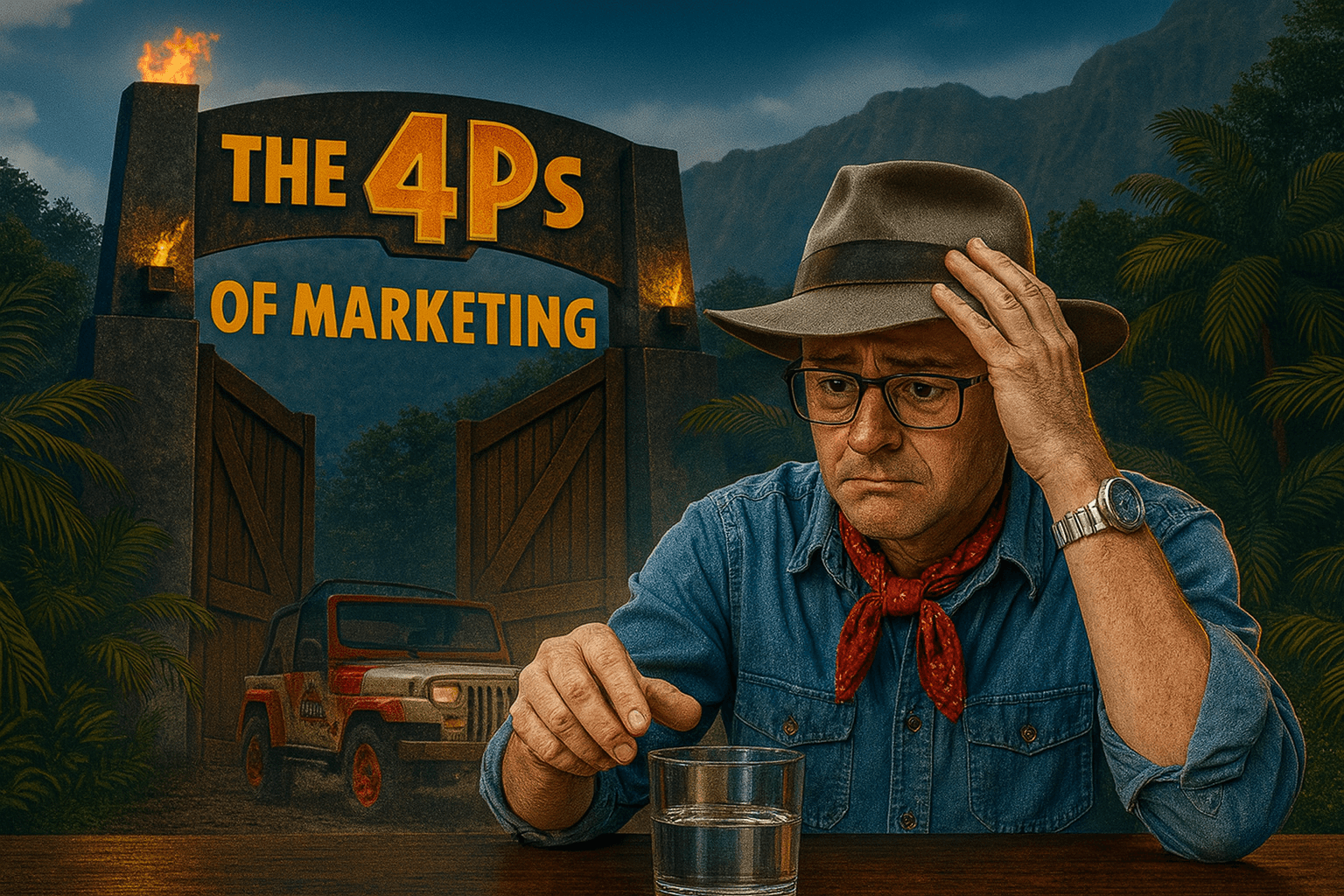
There’s a moment in Jurassic Park — the iconic ripple in the glass — that every marketer secretly relates to.
That tiny disturbance.
That subtle signal.
That “something big is coming” feeling.
Marketing today feels a lot like that moment.
Because the old model — Product, Price, Place, Promotion — the classic 4Ps every marketer was raised on, is shaking. And sitting still, relying on inherited frameworks, is a bit like building an amusement park full of dinosaurs and saying:
“What could possibly go wrong?”
(We all know how that went.)
Today’s customer journeys aren’t linear. Markets aren’t static. Attention isn’t guaranteed. And — great scot — metrics, channels and expectations evolve faster than a raptor on Red Bull.
So the question becomes:
Have the 4Ps served their time?
Or have they simply evolved into something more dynamic?
The 4Ps: The Park Map We All Started With
The 4Ps used to neatly define everything:
Product — what you sell
Price — what it costs
Place — where it appears
Promotion — how you communicate it
Simple. Elegant. Clean.
But here’s the thing:
People don’t buy in neat boxes anymore.
They pinball through ecosystems.
They discover, drop off, rediscover, convert, return.
Your product is the message.
Your customer is the channel.
Your price is your value story.
Your promotion is your flywheel.
The 4Ps still matter — massively — but not as standalone pillars.
They’ve become orbiting elements in something more alive.
Enter the Flywheel: “Delight → Amplify → Return → Compound”
Unlike the old “funnel,” a flywheel doesn’t end.
It builds momentum.
It looks something like this:
Delight - Deliver a product, service, or experience so good that customers feel compelled to talk about it.
Amplify - Use channels (content, community, media, social, CRM) to magnify that delight.
Return - Customers come back — not because you chased them, but because you've earned gravity.
Compound
Momentum grows.
CAC drops.
LTV rises.
Effort decreases.
Results accelerate.
Sound familiar?
It’s basically the opposite of Jurassic Park’s entire business model.
They amplified chaos.
Their “customers” did return — but running for their lives.
And things compounded… badly.
Why the Flywheel Isn’t Just “Good Customer Service”
This is where a lot of marketers oversimplify it.
“Isn’t the flywheel just… treat customers well and hope for the best?”
Absolutely not.
The flywheel is mechanical, not “magical”.
It requires alignment between:
Strategy (what are we solving?)
Insight (what do customers actually want?)
Product (does it deliver?)
Brand (do people recognise, trust and value it?)
Distribution (are we accessible?)
Measurement (are we learning?)
Leadership (are we aligned?)
“Great companies are built on repeatable engines, not one-hit campaigns.” — Duncan Rooney
That’s the essence of the flywheel.
You’re not pushing harder.
You’re reducing friction.
And building something that accelerates every time it rotates.
So… Have the 4Ps Become a Flywheel?
Yes — if you treat them as static, they fail.
But if you treat them as moving parts, they thrive.
Here’s how the 4Ps evolve inside a flywheel:
Old 4Ps | Modern Flywheel Reality |
|---|---|
Product | Experience, ecosystem, usefulness, retention |
Price | Value perception, trust, subscription, LTV strategy |
Place | Omnichannel, convenience, accessibility |
Promotion | Content, media, amplification loops, advocacy |
They don’t disappear.
They spin.
Why This Matters Right Now
Because the marketing world is drowning in KPIs, dashboards, ROAS charts, and “platform updates” every Tuesday.
Everyone is obsessed with metrics.
But metrics can become vanity very quickly:
Clicks without intent
Reach without relevance
Impressions without impact
Leads without quality
CAC snapshots without LTV context
Teams spend months “chasing numbers” that have no material impact on profit.
Meanwhile, the businesses that win are the ones focused on:
Getting the foundations right
Reducing friction
Aligning leadership
Building experiences people talk about
Creating momentum instead of moments
The flywheel turns because of foundations, not hacks (saying that I do love an MVP).
It’s the opposite of building a dinosaur theme park on unstable power generators and hoping the fences hold.
Foundation Before Flight: The Real Lesson
The flywheel only works if your foundations are right:
Clear strategy
Clear customer definition
Clear value proposition
Clear product experience
Clear measurement
Clear ownership
Without this, the 4Ps fall apart.
The flywheel stalls.
The raptors get out.
Nothing good happens and we all get eaten.
Final Thought
The 4Ps aren’t dead.
They’re just spinning faster.
Today’s best marketers aren’t choosing between old-school thinking and modern tools — they’re blending both.
Customer insight + defined KPIs + creative thinking + strategic leadership = momentum.
Or, in the words of Alan Grant:
“Life Finds a Way… But Your Marketing Won’t Unless the 4Ps Evolve.”
Sign-off
When strategy needs momentum and momentum needs direction, I can help you get there.